This Forum is now CLOSED use the link to get more details viewtopic.php?f=3&t=13924#p102587
User avatar
By Allanfox
#92194
Sorry if a pretty basic question but my manual has two conflicting torque settings for the head nuts on my 500 AVL engine, it has 24 and 33 Nmtrs mentioned in different places, anyone know which is correct?
User avatar
By Jojje
#92211
I remember wondering these figures myself. Explanation is simple: 24 stands for "ft/lbs" which corresponds 3.3 Nms.
User avatar
By Allanfox
#92212
Thanks Joffe, thought you had it but both are N/Mtr? Just a tad confusing!!
Attachments
AEC03079-5077-4B33-B07F-BB60CA7B3B35.jpeg
AEC03079-5077-4B33-B07F-BB60CA7B3B35.jpeg (30.52 KiB) Viewed 7193 times
D236ABAF-5053-4A5B-A027-D5922FCE01FD.jpeg
D236ABAF-5053-4A5B-A027-D5922FCE01FD.jpeg (30.9 KiB) Viewed 7193 times
User avatar
By Adrian
#92214
Torque wrench? Just nip the head nuts up nice and tight (by feel), and again after a hundred miles or so.

A.
By Cranky
#92217
Adrian is oh so correct. Don't use a torque wrench on Royal Enfields --just tighen it up snug.

Let me tell you a little story. When I went to RR school at Wilsden Green in london, a kid asked why don't RR give torque settings. The teacher with a waxed mustache in a white coat ( the teacher was in a white coat not the mustache) said if you dont know when a nut is tight we don't want you working on our engines.

In 1969 the only torque setting they gave was for the Mk v1 and that was a 6 cylinder with 39 1/2 inch studs.

As tight as you can with a 6 inch bar.

Applicable to anything

Look at the material and the thread and the size.
User avatar
By Allanfox
#92222
Cool and I am of the same school to be honest, funny If they didn’t publish torque settings I wouldn’t be asking, only ever give it thought on head nuts, in other areas I do go with feel. Thanks and good too about 6” bar!
User avatar
By Adrian
#92225
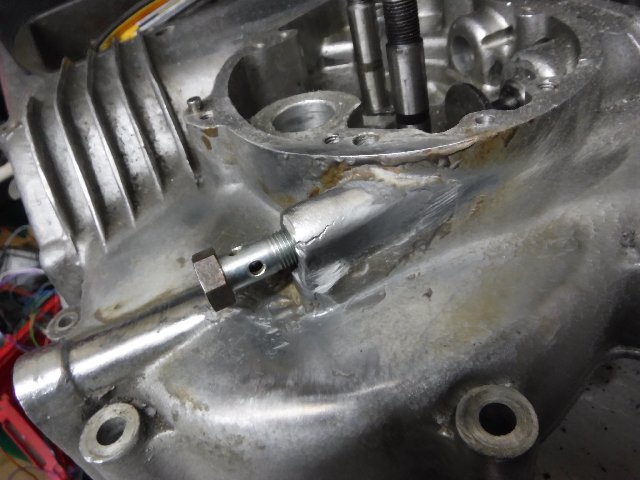
I sent my old Electra-X's crankcases to someone who'd used a torque wrench to tighten up the banjo bolt at the bottom of his Electra-X crankcases. OK, set wrench to the figure in the book (presumably) wind it on and CRACK! He then gave me the damaged crankcases to play with. Once the JB Weld emergency repair was cleaned off, this is what it revealed. At least the cylinder studs use a metric coarse thread, this one is M10 x 1.00, I think.

Image

A.
User avatar
By Jojje
#92228
Allanfox wrote:
Sun Aug 16, 2020 2:06 pm
Thanks Joffe, thought you had it but both are N/Mtr? Just a tad confusing!!
Yes, I have the same book. I've used 33 Nm in my Electra and nothing's broken.
User avatar
By Jojje
#92229
Allanfox wrote:
Sun Aug 16, 2020 2:06 pm
Thanks Joffe, thought you had it but both are N/Mtr? Just a tad confusing!!
Yes, I have the same book. Printers make mistakes. I've used 33 Nm in my Electra and nothing's broken.
User avatar
By PeteF
#92265
I'm old school and don't use a torque wrench much.
Except! Steel studs into alloy! It's oh so easy to overdo it. Steel on steel you have plenty of leeway but not steel into alloy. On fact, strictly speaking, you shouldn't do steel to alloy, there should be an insert.
You'd never find a alloy thread on anything really critical like an airframe.

Shop for accessories at Hitchcocks Motorcycles