This Forum is now CLOSED use the link to get more details viewtopic.php?f=3&t=13924#p102587
User avatar
By PeteF
#54621
If anyone's still interested. I think there is some confusion between atomic hydrogen and molecular hydrogen. I'm certainly confused :-) Now, whether a battery gives of H or H2 I don't know.
Quote:
One molecule of hydrogen dissociates into two atoms (H2 → 2H) when an energy equal to or greater than the dissociation energy (i.e., the amount of energy required to break the bond that holds together the atoms in the molecule) is supplied. The dissociation energy of molecular hydrogen is 104,000 calories per mole—written 104 kcal/mole (mole: the molecular weight expressed in grams, which is two grams in the case of hydrogen). Sufficient energy is obtained, for example, when the gas is brought into contact with a white-hot tungsten filament or when an electric discharge is established in the gas. If atomic hydrogen is generated in a system at low pressure, the atoms will have a significant lifetime—e.g., 0.3 second at a pressure of 0.5 millimetre of mercury. Atomic hydrogen is very reactive. It combines with most elements to form hydrides (e.g., sodium hydride, NaH), and it reduces metallic oxides, a reaction that produces the metal in its elemental state. The surfaces of metals that do not combine with hydrogen to form stable hydrides (e.g., platinum) catalyze the recombination of hydrogen atoms to form hydrogen molecules and are thereby heated to incandescence by the energy that this reaction releases.

Molecular hydrogen can react with many elements and compounds, but at room temperature the reaction rates are usually so low as to be negligible.
User avatar
By PeteF
#54624
Oh, sod it, I posted the last message on the wrong thread.
By jefrs
#54643
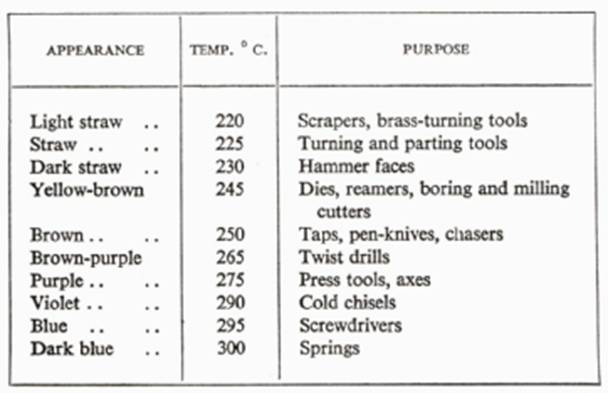
PeteF - if you google 'Tempering Colours For Steel" you'll find a whole load of charts like the one here http://www.thecartech.com/subjects/mach ... age001.jpg Yes, they are used to harden steels.

This one shows tempering colours to 1000°C http://i766.photobucket.com/albums/xx30 ... Page_1.jpg

Steel alloys colour at different temperatures, we do not want to go to red hot at over 1000°C because steel gets a mite soft then, which is why I said that, although I have seen glowing red hot bright cherry-yellow on a race engine, bad news it was too, slag. Do not confuse colour temperature (glowing in the forge) with tempering colour, the tempering colour remains after cooling. Fortunately chromium colours at a lower temperature than steel, unfortunately more vividly, so the straw to purple colours we see are at soft-soldering iron temperature (ouch) and not enough to soften the steel pipe or fry the head (aluminium melts at 660°C (oops)
By jefrs
#54644
2cvandy - I think you would have been told a PCv was fitted because they're not cheap. Or maybe it was unfitted before sale?


If you remove the O2/Lambda you have to fit a bypass resistor but you do not have to fit a PCv, it is well possible your bike never had one.


By smoother and more fun to ride with the PCv, like pottering uphill past the 30 gatso in 4th with hand off the throttle at idle.
User avatar
By PeteF
#54654
Jefrs
The point of my post was to correct your statement;
"The bluing is a tempering colour, happens when you heat metals to nearly red hot and let them cool."
This is just wrong. You do not get a blue finish on the metal if you go anywhere near red heat as the chart you referred me too shows.

Also:
"it is used to harden and temper steel"
Not quite. The tempering colours are used for tempering, yes, but not hardening.

My statement;
"I don't think taking steel to bluing temperature alters the hardness or temper"Is wrong. Going to blue does alter the temper of a hardened steel of course but I don't think it will effect the hardness of steel unless it has been previously hardened (I stand to be corrected on this but I have blued many parts without it seeming to alter the hardness) Bluing is often used on non hardened steel as a decorative finish which is also a rust resistor.
To harden steel you do need to go up to the red heat range and quench.
Not all steels will harden properly; it depends on their carbon content.

The fact that your down pipe has gone back to a straw colour means it's not getting so hot of course but, unless it has been taken up to red heat, it won't have been hardened. It is possible to get back to shiny chrome; there are plenty of products on the market to achieve this though they tend to be rather aggressive.
By jefrs
#54662
PeteF - you're nitpicking. When you forge steel you harden then temper, they're rarely done separately. Your definition of 'nearly' is a nicety.


Tempering alters the hardness down from fully hardened to something usable. The colouration is /used when/ you harden and temper, I shouldn't need to spell it out. Obviously I used 'nearly' very loosely. Bluing occurs at whatever temperature that steel blues at, somewhere around 500°C (give or take 100° or so). Soldering iron bits are still rated in Fahrenheit between 600°F and 800°F, they colour up straw or blue in use, some sort of cobalt-nickel magnetic steel. If you're in a forge then the difference between tempering temperature and cherry-red is not a lot, a couple of seconds at most; hence "nearly". You cannot see tempering colours when it's in the fire so you have to guess and pull it out and drop it in the bucket, or air quench; it depends what you're doing.


If you've got the tempering colour wrong in a forge then you do it again and again until it's right, it usually needs re-hardening, there's definitely an art to it, and in laying the coals to do it. Small jobs like jewellery might use a gas torch, same applies.
By Thack
#54663
Actually, the tempering colours occur a bit cooler than jefrs suggests. Red heat is 500C - 800C, tempering colours are much cooler:


Faint-yellow – 176 °C (349 °F) – engravers, razors, scrapers

Light-straw – 205 °C (401 °F) – rock drills, reamers, metal-cutting saws

Dark-straw – 226 °C (439 °F) – scribers, planer blades

Brown – 260 °C (500 °F) – taps, dies, drill bits, hammers, cold chisels

Purple – 282 °C (540 °F) – surgical tools, punches, stone carving tools

Dark blue – 310 °C (590 °F) – screwdrivers, wrenches

Light blue – 337 °C (639 °F) – springs, wood-cutting saws

Grey-blue – 371 °C (700 °F) and higher – structural steel


(Wikipedia)


Tempering is, indeed, a softening process which makes the steel tougher my reducing its brittleness.
User avatar
By PeteF
#54676
Oh, I'm well known for picking nits ;-)
You can see the colour change on small items if you use a torch as long as the steel is clean. You just remove the flame for a second and it's obvious. I do it regularly on anything up to 10mm.
As I mentioned previously, the best way to do it is using indirect heat (but this only works on small items.
To watch some beautiful bluing work, watch the last minute or so of this.
CLICK
The rest of this guy's videos are worth watching if you're in to machining.

Shop for accessories at Hitchcocks Motorcycles